
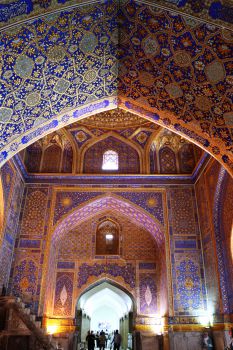
To date, collaborations between Sussex and the National University of Uzbekistan have resulted in the publication of an Uzbek language textbook on visual anthropology.
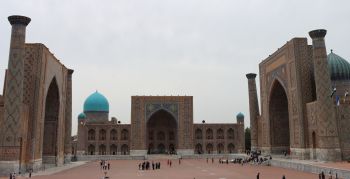
The Ambassador of Uzbekistan will visit the University of Sussex in May to discuss an extension of relations with institutions across Uzbekistan and ways of supporting their development and sustainability.
From a backdrop of growing relations between the Universities of Sussex and Uzbekistan, Professor Magnus Marsden met with H.E. Mr Ravshan Usmanov, Ambassador Extraordinary and Plenipotentiary of the Republic of Uzbekistan to the UK and Iceland, on 25 March 2026 to discuss the Memorandum of Understanding signed earlier in the year between Sussex and the National University of Uzbekistan – named after Mirzo Ulugbekov - and how best to sustain the collaboration.
To date, collaborations between Sussex and the National University of Uzbekistan have resulted in the publication of an Uzbek language textbook on visual anthropology co-authored by Anorkulov Sayfiddin Muhitdinovich, Ulug‘Bekov Oybek Otabek O‘G‘Li, and Dr Diana Ibanez Tirado (Associate Professor in Social Anthropology) - who also led the signing of the MoU on behalf of Sussex.
Oybek Ulugbekov, Lecturer in the Department of Ethnology and Anthropology at the National University of Uzbekistan said:
“As a graduate of the Anthropology department at the University of Sussex, I highly value the academic opportunities and scientific potential of this higher education institution. Since the field of social anthropology is still in its early stages of development within the academic community of Uzbekistan, the Memorandum established between our universities holds significant importance for the further advancement of the Anthropology and Ethnology academic direction at the National University of Uzbekistan. In particular, it will enhance researchers' scientific and professional skills and enrich the field with new academic literature. Notably, the recently co-authored textbook on Visual Anthropology, written with Dr Diana Ibanez Tirado, serves as an example of the initial stage of this academic collaboration.”
The Sussex Asia Centre has also arranged for the Ambassador of Uzbekistan to visit the University of Sussex in May to discuss an extension of relations with institutions across Uzbekistan and ways of supporting their development and sustainability.
Dr Diana Ibanez Tirado said:
“Central Asia has historically been rich in cultural and environmental diversity and of strategic importance due to its location between imperial powers such as Russia, China, and Britain. Uzbekistan, situated at the centre of the Silk Road, offers insights into Islamic architecture, Soviet heritage, and regional and global networks. The MoU seeks to enhance collaboration and deepen understanding of Uzbekistan and the wider region, creating opportunities for exchanges beyond social sciences and humanities, where some achievements, like a joint publication, have already taken place.”
Linked to these activities in Uzbekistan, Magnus Marsden, Professor of Social Anthropology and Head of the Department of Anthropology at Sussex, was appointed a visiting academic scholar for the Silk Roads programme at King's College from May 2026. Directed by acclaimed author, Peter Frankopan, the programme focuses on the study of the history and culture of countries, societies, and cultures of the Silk Road from China to the Mediterranean Sea.
Professor Marsden said:
"Sussex Anthropology and the Sussex Asia Centre are delighted to have established this relationship with colleagues in Tashkent. I hope the collaboration will further deepen our relations with institutions and scholars in Uzbekistan and help to ensure that the work we conduct there reflects the priorities and concerns of the region".
The Department of Anthropology and the Sussex Asia Centre have an established focus on the study of contemporary Central Asia with scholars working on a range of issues including, health, wellbeing and society in Tajikistan; trade, commerce and mobility; education and society; and religion, heritage, culture and minorities. It is hoped that developing collaborations with Tashkent will deepen relations with institutions and scholars in the region and ensure that collective endeavours reflect the priorities of scholars in the region.