
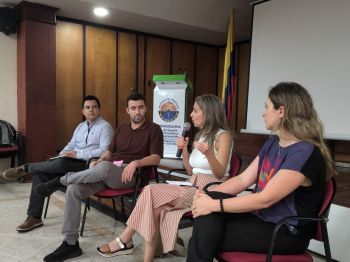
Sussex participants discussed pathways for strengthening collective action and identifying legal and socio-economic strategies to support the transition.
A key moment in climate diplomacy
The shift away from fossil fuels is no longer just a climate goal. In fact, for 30 years UN climate negotiators failed to name fossil fuels as the primary driver of the climate crisis.
Moving away from fossil fuels demands a wider process of economic change and energy security, which requires coordinated planning, international cooperation, enhanced investment, and public support.
The First Conference on Transitioning Away from Fossil Fuels, held between 24–29 April in Santa Marta, Colombia, aimed to build on this understanding and advance collective efforts to move away from fossil fuel extraction.
A key moment in climate diplomacy following COP30, the event was co-hosted by Colombia and the Netherlands. It brought together 57 countries, representing one-third of global fossil fuel consumption and one-fifth of global production, for dialogue, workshops, and science-led discussions on pathways to a global shift.
Academics and researchers from Sussex's School of Global Studies and the Institute of Development Studies (IDS) joined ministers, diplomats, civil society groups, campaigners, Indigenous Peoples, NGOs, and local communities to discuss options and barriers.
Shaping energy transition talks
Sussex participants discussed pathways for strengthening collective action and identifying legal and socio-economic strategies to support this shift. They engaged with academic, policy and civil society stakeholders and launched the Sussex-supported CFAL Fossil Fuel Reduction Network for Latin America and the Caribbean.
Professor Peter Newell, whose work on climate change and energy was recently featured in Financial Times, led the Sussex SUS-POL team, comprising Dr Daniela Soto-Hernández, Dr Lukas Slothuus, and Research Associate Freddie Daley.
Professor Newell presented their legal research on a fossil fuel treaty to governments supporting the initiative. The team also led a workstream on fossil fuel phaseout policies and contributed to a synthesis report. They joined intergovernmental discussions, engaged with international media, and co-organised a workshop on Colombia’s energy transition with the Natural Resource Governance Institute.
Guy Edwards, Postgraduate Researcher and co-director of the LAC Research Network at Sussex, also participated in the conference as part of the Climate Social Science Network (CSSN). He organised the CSSN event From Obstruction to Action: Strategies for a Just Energy Transition where, alongside Latin American colleagues, he discussed opposition to fossil fuel phaseout and presented his doctoral research on climate obstruction in Colombia.
Colombian IDS Postgraduate Researchers Camila Fernández Hernández and Paula Alejandra Camargo also attended and engaged in various activities throughout the week.
Conference outcomes
Bringing together scientific, public sector, and civil society perspectives, the Conference is helping shape plans for a fossil fuel phaseout and strengthen collective action, with discussions set to inform coordinated global climate action.
“It launched work on national roadmaps to move away from fossil fuels, financial reform, and decarbonising trade, with a coordinating group and science panel, further advancing coordinated action for upcoming UN climate talks,” said Peter Newell.
“For a PhD student focused specifically on Colombia’s energy transition, it was an enormous privilege to be there, share my doctoral research and observe some of my project interviewees bring about this historic undertaking,” added Guy Edwards.
The voyage continues – read about The Second Conference for the Just Transition Away from Fossil Fuels taking place in 2027 in Tuvalu, co-hosted with Ireland.