
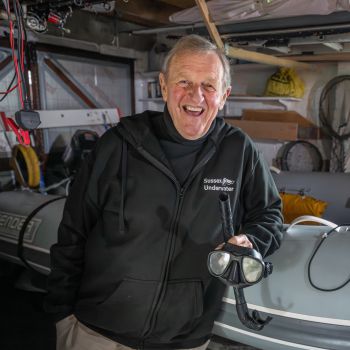
Eric Smith
Eric Smith will be conferred honorary Doctor of Science at Winter Graduation 2026 for his tireless campaign to restore the marine life of the Sussex coast.
Eric Smith still gets emotional when he thinks about the day a trawling ban came into effect on the Sussex coast in 2021.
A keen diver since childhood, 77-year-old Eric had been campaigning for more than 30 years to get governments to change fishing practices. He had witnessed how the seabed near his home in Shoreham had been stripped of kelp seaweed by inshore trawlers, leading to a huge reduction in marine life.
“It was heartbreaking to see an eco-system destroyed,” he says. “But for years, no one listened to me.”
Until they did.
In 2008, after witnessing a particular trawling incident in Bognor that left hundreds of small fish who had escaped the nets dead in the water, he authored an article that was published by The Royal Yachting Association magazine.
This came to the notice of Sean Ashworth, who worked for the Sussex Inshore Fisheries and Conservation Association (IFCA). In support, Sean began to draft documents to change the legislation.They also teamed up with filmmakers Big Wave Productions to make a documentary, Help our Kelp, with a narration by Sir David Attenborough. The film, released on YouTube in 2019, describes the essential role kelp plays in providing food and shelter for marine animals, and how it helps to absorb carbon from the atmosphere.
Soon the campaign was being backed by Sussex Wildlife Trust, Blue Marine Foundation and other organisations, while Eric wrote to Prince Charles (as he was, at the time), the then Prime Minister Boris Johnson, and Sir David Attenborough to raise awareness. When the IFCA consultation went out, 2500 people wrote to support the campaign.
Now the Sussex Nearshore Trawling Byelaw area extends along the entire Sussex IFCA district, between 0.75km to 1km from Chichester Harbour in the west to Rye Bay in the east. It is the largest marine rewilding project in the UK.
“If the byelaw hadn’t been brought in, the kelp would have been totally wiped out within five years,” says Eric.
The ban will be reviewed in 2026. Eric is sure that it will stay in place. “If it goes now, there would be an uproar.”
Not surprisingly, Eric has become an inspirational figure for environmental campaigners. Big Wave made another documentary, Our Lives: Our Sea Forest, for the BBC, about Eric, narrated by naturalist Chris Packham CBE. Eric is also referenced in Sir David Attenborough’s book, Ocean, about the devastation of our marine world.
Eric’s love for the sea began at the age of 11, when he first went snorkelling with his friends in Shoreham and saw the abundance of fish and marine life.
With a makeshift spear, he caught a huge turbot and took it home. “We were only just out of rationing – and that kept us in fish for a week.”
A lorry driver by profession, Eric kept up his passion for the sea by becoming a spear fisherman, competing across the world and earning the British champion title four times.
It was in the 1980s, when the effects of intensive inshore trawling were compounded by the devasting effects of the Great Storm in 1987, that he became aware of what was happening to the seabed.
The loss of kelp – estimated to be 98% – was affecting all other marine life. The squid, seahorses, and stingrays he had seen as a teenager were no longer there.
Since the ban, efforts to restore and protect kelp have continued to gather momentum. The Sussex Kelp Recovery Project has been set up by a group of organisations to monitor the recovery of the area, including researchers at the University of Sussex.
Eric says early signs are already there, particularly in the mussel beds that hold the seabed together. “When we first started filming about five years ago the, mussel bed covered the area of a tennis court. Now they cover an area from Worthing to Brighton – nine miles.”
Meanwhile, Eric and his daughter Catrine Priestley have set up their own charity, Sussex Underwater, which involves advocating for sustainable fishing practices, and giving talks and showing film footage in schools to educate younger generations about why the seas need protection.
Catrine says: “People don’t think about the sea in the way they do about the land. We can see the destruction of forests but we cannot see what’s happening under the water. That’s why our film footage is so effective.”
She says there’s also a despondency in our society, fostered by the media, “that it’s all doom and gloom” and that individuals are powerless to change things.
“But we say to the schoolchildren that one person can make that difference. It took a long time, but with his drive and passion, Dad did it. He is the most optimistic person you will ever meet. Those key elements come together to make someone who makes a difference.”
Film footage below is by Sussex Underwater and features Eric diving along the Sussex coast.