
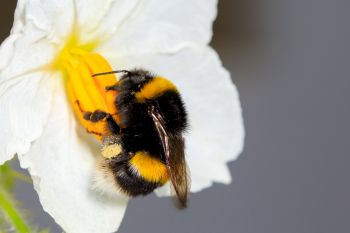
This World Bee Day (Wednesday 20 May), researchers from the University of Sussex and Uppsala University Sweden, reveal that the powerful vibrations bees use to collect pollen from flowers come at a surprisingly high energy cost, shedding new light on the hidden challenges of pollination.
The study released today by The Royal Society shares the first direct measurement of the energy required for “floral buzzing” - a specialised behaviour used by many bees to shake pollen loose from flowers, including crops such as tomatoes and blueberries. Many of the world’s flowering plants depend on this technique to be pollinated.
Monitoring the physiology and behaviours of buff-tailed bumblebees (Bombus terrestris), the scientists used specialised lasers to simultaneously measure both the vibrations produced by bees and their carbon dioxide production.
The team found that floral buzzing is one of the most energetically demanding activities a bee performs. Collecting pollen requires roughly the same amount of energy as flight take-off and because buzzing bouts often last much longer than take-off, total energy exertion is likely to be much greater.
Dr Beth Nicholls, Principal Research Fellow (Ecology an Evolution) at the University of Sussex says: “The findings suggest that floral buzzing could represent a major part of a bee’s daily energy budget, something that has previously been overlooked. These bees must carefully choose which flowers they visit to ensure they have enough energy to pollinate.”
The researchers found that when flowers produce less sugary nectar, bees need to visit more flowers to replace the energy lost during buzzing. This may affect which plants bees choose to visit and how effectively they pollinate crops.
Some bees were found to be more energy-efficient than others, highlighting how these differences could further affect foraging behaviour.
Research lead and University of Sussex Research Fellow Natacha Rossi says: “As nectar availability shifts due to climate change or habitat loss, the energetic demands of pollination could influence bee behaviour and, ultimately, where bees forage and which plants they pollinate. These results help us to better understand plant-pollinator relationships and just how hard at work a buzzing bee really is.”
By understanding this behaviour, researchers can now better predict how bees might adapt their foraging behaviours in future because it so demanding to visit certain flowers.
Uppsala University’s Professor Mario Vallejo-Marin says: “We long suspected that buzz pollination was an energetically expensive affair. We can now put a number to it and begin making quantitative predictions of how it could affect the ecology and evolution of bees and buzz pollinated flowers."