

Accounting and Finance are important for building a green future by guiding sustainable investment choices, shaping corporate strategies, and identifying technologies most likely to succeed.
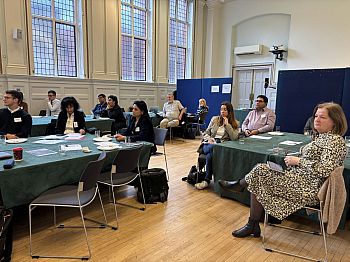
To deepen insights into these roles and the psychological and social processes that influence financial decision-making, the Accounting and Finance Department at the University of Sussex Business School partnered with Accounting for Sustainability (A4S) to host a research engagement event in London on Tuesday, 18 November 2025.
Led by Dr Massimo Contrafatto, the event brought together experts from academia, industry, and policy to explore the role of accounting and finance in driving a sustainable future. It also aimed to highlight the extent to which accountability practices can be used to promote sustainable change in decision-makers’ mindsets, values, and perspectives. The event formed part of the Department’s ongoing collaboration with A4S on “Sustainable Decision-making and Accounting: the role of professional identities and related psychological processes."
Among the attendees were Professor Gonul Colak, Head of Department, Business School’s Accounting and Finance Department, Dr Maria Carvalho, Head of Policy, Research and Insights, NatWest, Jeremy Nicholls, Advisor at Social Value International, and Helen Slinger, Executive Director, Knowledge and Learning, A4S.
Dr Carvalho argued that aligning sustainability with the financial sector requires tackling two major challenges: correcting mispriced risk and boosting consumer demand. She noted that traditional credit models—built on historical data—are not equipped to account for the future size of climate-related risks.
She pointed to 2022’s sharp rise in fossil fuel, fertiliser, and chemical prices due to the Ukraine-Russia crisis as a natural stress test and good historical data point. By comparing how households and firms with higher exposure to fossil-fuel price shocks (including those for chemicals and fertilisers) fared with those with lower exposure, researchers can generate clearer evidence on whether financial institutions are mispricing climate risk. Such analysis, she added, is essential for influencing how financial institutions assess future sustainability risks.
 She also highlighted the importance of real-economy signals: strong customer demand and clear policy direction, as seen in markets like Europe and China, can unlock significant sustainable investment. Achieving this, she added, depends on system-level change, including shifts to green energy, new infrastructure, and circular-economy models that reduce waste and reliance on fossil fuel inputs.
An expert panel expanded on how accounting and finance can better support the drive for a greener future.
Drawing from his research, Professor Colak noted that corporate sustainability efforts remain poorly represented in existing accounting disclosures. Pulling evidence from Europe, he said that while firms are expected to report on their sustainability activities, current disclosure standards fail to capture the intangible value created by corporate social responsibility. He called for reforms that would allow accounting to reflect these non-financial contributions more accurately.
Jeremy Nicholls argued that accounting should highlight not only economic outcomes but also human wellbeing. Helen Slinger, on her part, stressed the importance of multi-capital accounting that incorporates natural, human, and social capital to foster more responsible decision-making.
Experts that participated in the event agreed that accounting and finance play significant roles in driving a greener future through better risk pricing, transparent disclosures, ethical practices, and multi-capital approaches. These actions eventually enable system-level sustainable change.