
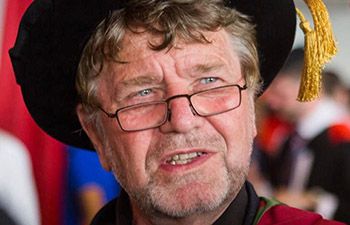
Professor Chris Chatwin passed away on the evening of Sunday 11 January 2026. He had been living with cancer and had only retired the previous summer.
Chris commenced his career as an engineering apprentice for the Austin Motor Company in his home city of Birmingham. He remembered his time as an apprentice with fondness, making many friends during that period, several of whom he kept in touch with and continued to meet in Birmingham for annual reunions.
With strong performance as an apprentice, Chris was sponsored to attend Aston University to gain a degree in Mechanical Engineering (exceptionally as most apprentices were sponsored to study Production Engineering). After graduating, he returned to what had since become the British Leyland Motor Company in a junior management role. There he honed his negotiating skills in disputes with the trade unions that were characteristic of the 1970s.
After several demanding years he decided to return to academic study and joined the University of Birmingham to undertake an MSc in Thermodynamics, a subject he retained a passion for throughout his life. He gathered many of the classic texts on the subject in his large collection of engineering textbooks – Boundary Layer Theory by Schlichting was a particular favourite.
Chris stayed on at Birmingham to undertake a PhD in Laser Design under the supervision of Brian Scott. He only had two years of funding but, working long hours, he successfully completed a very detailed thesis in the time available.
Chris then moved to the University of Glasgow as a lecturer when Brian Scott was appointed to the James Watt Chair in Engineering at Glasgow. With Brian, he established the Laser and Optical Systems Engineering Group (LOSEG). The group won funding to design and build a large 10kW pulsed CO2 laser but the funding was quite limited, so Chris had to undertake much of the design work himself. To do this, he taught himself how to use one of the first Computer-Aided Design systems, on which he drafted the full engineering drawings for the laser. He also wrote a large piece of Fortran code to model the resonator structure which unfortunately the 1980s University mainframe struggled to cope with.
During his time at Glasgow, Chris supervised around a dozen PhD students to completion and began to publish his research widely. LOSEG continues today, run by former colleagues Ian Watson and Jim Sharp.
In the spring of 1995 Chris moved to the University of Sussex as a newly appointed Chair in Engineering where he established the Industrial Informatics and Signal Processing Research Group. There he was joined by Rupert Young, Phil Birch, and Tai Yang. We succeeded in obtaining several grants through which we developed some novel engineering systems.
During the past 30 years at Sussex, Chris supervised more than 50 PhD students to completion, many of whom are now in leading positions in industry and academia worldwide. As further evidence of his productivity, Chris has one of the largest entries on the University research archive with more than 460 publications recorded.
Chris worked nine years past normal retirement age, finally retiring only last summer. During that period, he was fully active in both the Department of Engineering and Design and the academic community more widely.
Chris developed a comprehensive module in Manufacturing Technology, which he delivered to all first year Engineering students, drawing on his deep knowledge and practical experience of the subject. He also delivered a Masters’-level module on Advanced Manufacturing methods. He continued supervising PhD students, developing research interests in software interoperability issues in manufacturing and latterly in healthcare.
Chris reviewed over 800 papers in his role on the General Engineering Panel for the 2021 Research Excellence Framework, carefully reading each paper in detail so he could give an accurate rating. He was also a very regular reviewer for Engineering and Physical Sciences Research Council grant applications.
In addition to a heavy academic workload, Chris took on the Presidency of the Sussex Branch of the University and College Union. In this role he established improved committee structures and took a particular interest in casework, employing his formidable negotiating skills to defend the positions of staff members who had encountered difficulties in their careers.
In retirement, Chris was keeping just as active, continuing to produce research papers with former students and review grant proposals. He had spent a lifetime understanding engineering systems and in later life was becoming interested in the much more difficult task of understanding the human condition. He began to read widely in history, particularly economic and political history. He had developed an interest in the East India Company and was even considering writing a historical novel set in the period.
Chris is survived by his four children Elle, Craig, Andrew, and Jasmine and his two granddaughters Beatrix and Milenna.
Authors: Rupert Young and Phil Birch, Department of Engineering and Design
Funeral arrangements
Professor Chatwin’s funeral will be held at the Downs Crematorium (Bear Road, Brighton BN2 4DZ) on Tuesday 3 February at 12 noon. This will be followed by a reception at The White Horses (High Street, Rottingdean BN2 7HR) from 1.15pm, to which all are welcome to attend. More details on the funeral arrangements, including how to attend remotely.
In lieu of flowers, the family is collecting donations for the Martlets Hospice.