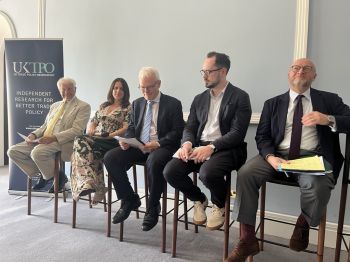
Chair of the Business and Trade Select Committee, Liam Byrne MP, joined researchers and business leaders yesterday (Monday 22 June) to discuss the state of the UK’s trading fortunes at Carlton House Terrace, Westminster.
Marking the tenth anniversary of the Brexit vote, speakers at the University of Sussex’s UK Trade Policy Observatory (UKTPO) event examined the future of UK-EU cooperation and how best to support economic prosperity in an increasingly fragmented global landscape. On a day in which the Prime Minister resigned, panellists called for greater clarity over the goals of policy, highlighting defence and economic security as key issues, and considered how to align trade policy with domestic goals and micro-economic reform, as opposed to thinking that trade agreements in themselves are the answer.
Announcing a new Select Committee report taking stock of EU relations, Liam Byrne MP, warned that the economic damage done by Brexit will not be reversed by the government’s current Reset plans, that are only projected to deliver a 0.5% lift to GDP by 2040.
Liam Byrne MP said: “The thing that strikes me hardest today is the gap between political rhetoric and economic reality. Ministers have dialled up their words against Brexit, but the solutions being presented will give us less than a 1% uplift in GDP. So that’s a 1% solution to what is optimistically a 4% loss from Brexit. That has led to all sorts of political consequences, one of which is the rise of populism and left us going through Prime Ministers faster than Italy. This is a national strategy moment, and we need a much bolder vision based on the world we’re in, that includes better cooperation with Europe.”
Although agreeing on how Brexit has damaged trade and hamstrung policymakers, members of the UKTPO and business representatives fell short of advocating for an immediate move to rejoin the EU. Instead, they discussed the stable conditions needed to support business confidence and mutually beneficial trading relationships in the years ahead.
UKTPO founding Director and University of Sussex Emeritus Professor L. Alan Winters said: “In addition to its very real economic costs, Brexit has hugely disturbed UK politics and blocked rational discussions on challenges to trade – both with the EU and the rest of the world. Ten years on there’s still no agreed post-Brexit vision. Until this materialises, policy is going to continue to be rather chaotic. And while I am a fan of returning to the EU eventually, we have to address issues like energy, skills and investment at home first.”
Allie Renison, Senior Counsel at SECNewgate said: “We need to get to a position of stability and problem sharing with the EU that survives contact with as many political realities as possible. Businesses depend on it. My slight scepticism with the EU Reset is we’re talking about how to cooperate, before finding out what we want to achieve. I would prefer to pinpoint our shared interests and stop taking alignment as the only measure of success.”
Formed in 2016, right after the referendum, the UKTPO is a University of Sussex Centre of Excellence. Its focus on policy engagement and outreach activities on international trade policy helps businesses and policymakers navigate the many challenges presented by Brexit and other threats to the international trading system.
Co-Director of the UKTPO, University of Sussex Professor Emily Lydgate said: “We formed UKTPO in the wake of the leave vote as a response unit to Brexit and trade has continued to be at the heart of domestic turbulence ever since. Now we’re seeing a new round of market access restrictions in Europe, raising once again the question of whether the UK will fall outside of EU regulatory boundaries, and what this means for the government’s growth agenda. But pursuing a closer relationship with the EU also raises the question of who decides how much we align, and what that means for how voters feel they’re being represented.”
Lord Karan Bilimoria, CBE DL, Chair of the International Chambers of Commerce, said: “Businesses are interested in the future not the past, and 74% now say uncertainty is a bigger challenge than tariffs. We’re the second largest services exporter in the world, and still the eleventh largest manufacturer yet our GDP per head compares poorly to countries around us. We desperately need better productivity and that includes confronting the fact that the loss of freedom of movement is horrible for business. The EU is still our biggest and most important trading partner in spite of everything over the past 10 years. We have the strongest combination of hard and soft power in the world and we need to capitalise on that.”
Sam Lowe, Partner at Flint Global said: “No one wants to have the hard conversations. If we want to align more with the EU the cost of that is a serious conversation about freedom of movement. The other option is to go all in with the US and take the hit on losing ties with Europe. There’s two ways to go here, and the bumbling along version where we try to keep everyone happy has its own trade off. It gives you a kind of moral superiority, but we won’t win economically.”
In addition to the speakers quoted above, Monday’s debate was chaired by Creon Butler, Director of the Global Economy and Finance Programme at Chatham House.