

Dr Elizabeth Rendon-Morales
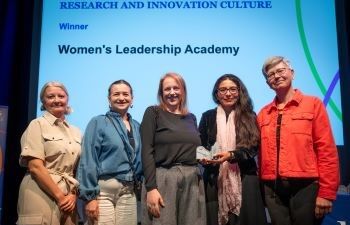
Pro-Vice-Chancellor of Research and Innovation Professor Maria Fasli, Professor Erika Mancini, Katy Stoddard, Dr Elizabeth Rendon-Morales, and Vice-Chancellor Professor Sasha Roseneil.
The Sussex Awards ceremony took place in April 2026, celebrating outstanding achievements across the University. In a series of interviews, we’ll hear from the award winners and get a closer look at their work.
Here, we speak to Dr Elizabeth Rendon-Morales about the Women’s Leadership Academy, winners of the Research and Innovation Culture award. The team won for designing and delivering an impactful and sustainably funded programme that addresses the gender gap in promotion applications among early career researchers.
Describe the moment you found out you’d won a Sussex Award
I felt incredibly happy and deeply validated when I found out I had won. It was a powerful recognition of the hard work, commitment, and passion that went into designing the Women’s Leadership Academy (WLA), as well as acknowledgement of the clear need for a leadership programme dedicated to supporting women Early Career Researchers (ECRs).
Receiving the award filled me with a profound sense of pride and renewed purpose. It reinforced my belief in the importance of creating initiatives that promote equality, diversity, and inclusion, and that help foster a more supportive and inclusive research culture.
The award also reflected the strong spirit of collegiality that the WLA has cultivated among women ECRs. It reminded me of the privilege of working alongside my wonderful colleagues, Prof. Erika Mancini, Vicki Love, and Katy Stoddard, whose dedication, expertise, and collaboration were instrumental in making the WLA such a meaningful and impactful programme.
What advice would you give to those who would like to run a successful initiative?
My advice is to start with a clear purpose but never try to achieve it alone. Meaningful and lasting change happens when people work collaboratively, build strong partnerships, and create communities that support one another.
The success of the Women’s Leadership Academy has shown me the power of community. My own sense of belonging within academia has been strengthened through this work, and it has reinforced my desire to help others flourish in their research careers. Seeing participants grow in confidence, build supportive networks, and realise their leadership potential has been one of the most rewarding aspects of the initiative.
Above all, listen to the people you aim to support, be guided by their needs, and bring together colleagues who share the same vision. When a community is built on trust, collaboration, and a genuine commitment to helping others succeed, meaningful change can happen.
What was the most challenging obstacle you overcame while working toward this achievement?
The most challenging obstacle was demonstrating the genuine need for a tailored leadership programme specifically designed to support women researchers. While the underrepresentation of women in research leadership is well documented, it was important to show that women Early Career Researchers (ECRs) would benefit from a programme that addressed their specific experiences, challenges, and aspirations.
We launched the pilot programme with the goal of introducing participants to the Designing Your Life methodology, helping them reflect on and shape careers that aligned with their values, research strengths, and ambitions. At the same time, we sought to understand the barriers that women researchers face in progressing their academic careers and identify practical ways to support their development and retention within academia.
Securing funding for the programme was also a significant challenge. We needed to build compelling evidence and demonstrate that investing in the development of women researchers would generate benefits not only for individuals but also for the wider research ecosystem. We were fortunate to receive valuable support from the University's Research Development Concordat, the Equality, Diversity and Inclusion (EDI) Unit and the Research and Innovation Culture Unit.
Looking back, overcoming these challenges has been incredibly rewarding.
Describe the impact of the project
The Women’s Leadership Academy (WLA) has had a transformative impact on the confidence, agency, and career aspirations of women Early Career Researchers (ECRs). Our evaluation demonstrated a significant shift from self-doubt to self-belief, with participants reporting an increased ability to challenge limiting assumptions, recognise their own potential, and take proactive steps towards their career goals.
As one participant reflected:
“We are so often told by messaging in society that you can’t. But the WLA messaging is that you can.”
This increase in confidence and self-efficacy is particularly important in enabling women researchers to pursue opportunities that they may previously have considered beyond their reach. By empowering participants to navigate their careers more strategically, the programme has the potential to increase both the volume and value of future grant and fellowship applications.
Beyond individual development, WLA has fostered a strong community of women researchers across disciplines, creating networks that continue beyond the programme itself and strengthening confidence, leadership capability, and peer support
Importantly, the Women’s Leadership Academy aligns closely with the sector's growing recognition that a positive, inclusive, and supportive research culture is essential for research excellence. As reflected in the evolving Research Excellence Framework (REF), universities are increasingly expected to demonstrate how they nurture people, develop talent, and create research environments in which everyone can thrive.
If you had to describe your project in three words, what would they be?
Empowerment; leadership; community.
These three words capture the core purpose of WLA empowering women researchers, developing their leadership potential, and building a supportive community that enables them to thrive.
Describe your perfect day
A perfect day for me would be spending a sunny summer day on the Sussex campus, working in our research lab and seeing exciting ideas evolve into innovations with real-world impact. I find it incredibly rewarding to support and mentor my PhD and MSc students—many of whom are women— as they develop advanced research skills, grow in confidence, and establish themselves as independent researchers.
One of the most fulfilling aspects of my work is collaborating with clinicians and NHS partners to tackle important healthcare challenges through engineering and technology. I co-lead of the Sussex High Precision Robotics and Sensing (HPRS) Lab, alongside Dr Rodrigo Aviles and I am inspired by the creativity, curiosity, and teamwork of our researchers driving advances in robotic microscopy, high-content imaging, and biomedical instrumentation research.
Seeing students, researchers, and clinicians come together to solve complex problems, while knowing that our work has the potential to improve people's lives, makes for a truly perfect day.