

Dr Moira Dustin
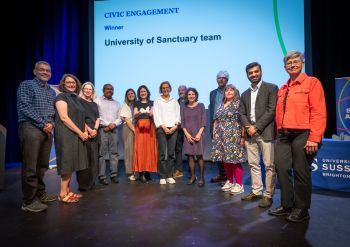
The University of Sanctuary team collecting their Civic Engagement Award.
The Sussex Awards ceremony took place in April 2026, celebrating outstanding achievements across the University. In a series of interviews, we’ll hear from award winners and get a closer look at their work.
Here, we speak to Dr Moira Dustin about the University of Sanctuary team, winners of the Civic Engagement Award. The team won for demonstrating a collaborative programme of support for refugees and sanctuary-seeking students, spanning scholarships, language programmes, widening participation initiatives and local government partnerships - all co-designed with students who have lived experience.
Describe the moment you found out you’d won a Sussex Award
I was so pleased, then I wondered how we could fit everyone who made it happen into the group photo – there were a lot of us!
What advice would you give to those who would like to run a successful initiative?
Collaborate. Take advantage of all the expertise, passion and commitment there is out there, within and beyond the University. We couldn’t do what we’re doing without input from colleagues in many different parts of the University, and from partners like local non-governmental organisations, people at Brighton and Hove City Council, and colleagues on the Eastern Arc of Sanctuary. For me, these collaborations exemplify and make meaningful some of the buzz words we’re all familiar with, like knowledge exchange, co-production and impact. They also mean we’re building on what other people and organisations are doing, learning from them and sharing good practice.
On a personal level, it has been so enjoyable finding out about the many people doing supportive and inclusive things locally under the very broad umbrella of ‘Sanctuary’.
What was the most challenging obstacle you overcame while working toward this achievement?
The biggest challenge probably was and remains, capacity. There are so many things we could do and want to do to realise Sanctuary objectives, and because this is the University of Sussex everyone involved is full of creative ideas for worthwhile activities. But of course, this is a tough time for colleagues here and in higher education more broadly. Some wonderful colleagues on the Sanctuary team have recently left. We’re dealing with this by having a very realistic Sanctuary action plan with an achievable number of activities planned for each semester.
Describe the impact of the project
This work has already had so many impacts with potential for more. Of course, it’s about supporting our Sanctuary scholars in concrete ways that improve student experience and support as many students as possible. But it’s also been a lever to increase awareness of Sanctuary across the University, for example, through the warm and wonderful Sussex Sanctuary Celebration event we held in April.
We’ve used our Sanctuary status to make connections locally (helping staff and students volunteer with the Migrant English Project) and globally (hosting the Women in Refugee Law (WiRL) network). Sanctuary activities have facilitated collaboration and engagement between people in different departments, schools and faculties, enhancing the interdisciplinary values of the University.
For me, this has played a key role in creating a culture of care, kindness and inclusivity at Sussex, and a push-back against some policies we are currently seeing, such as the Government’s ‘Visa Brake’ policy that the University is opposing.
If you had to describe your project in three words, what would they be?
Supportive; collaborative; realistic.
Tell us about your perfect day out in the local area
On a summer’s day I can’t imagine anything better than a swim at the beach followed by an ice cream (coffee or pistachio flavour), and in the evening, a Masala Dosa at Madrasi’s in Hove with friends.