
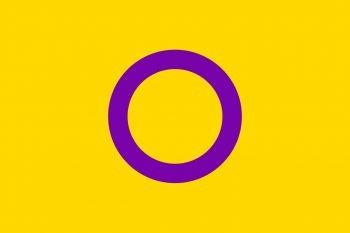
Intersex Awareness Day was first established in 2004 to highlight human rights issues faced by intersex people. Intersex people are born with characteristics — sometimes physiological; sometimes chromosomal; and sometimes concerning how their body responds to hormones — that are at odds with the common understanding of what it means to be either 'male' or 'female'.
Support for staff and students
- Our Trans, Non-Binary and Intersex Staff Network at Sussex is a confidential and fully inclusive group open to all Sussex staff who identify as trans, non-binary or intersex. You can join the confidential mailing list by contacting transnonbinarystaff@sussex.ac.uk. The mailing list is monitored and accessed solely by the Chair of the Trans and Non-binary Staff Network.
- Staff members who identify as LGBTQ+ can join our LGBTQ+ Staff Network by contacting lgbt-staff@sussex.ac.uk. The LGBTQ+ Staff Network arranges events and activities through the year, and provides an informal network of LGBTQ+ staff. Many of their events are open to all staff, and some events are also open to students. To find out more, see the Staff Networks page.
- Students who identify as trans and/or non-binary, or who are intersex, can contact the Students’ Union Trans and Non-Binary group by emailing transnonbinary@sussexstudent.com. They can also get involved with Transcend, a SU-affiliated Campaign and Network aimed at uplifting the lives of trans, non-binary and gender non-conforming students at the University of Sussex and beyond: transcend.sussex@sussexstudent.com
- Students who identify as LGBTQ+ can join the Students’ Union’s LGBTQ+ Society and contact the Students’ Union officers for support.
- The University of Sussex is committed to providing a safe, inclusive and respectful environment for every member of its community. If you or someone else has experienced behaviours such as bullying, harassment, a hate incident, sexual violence, domestic abuse or discrimination, you can let us know using Report and Support.
- The University’s Wellbeing Support Guide contains a dedicated section signposting to a variety of LGBTQ+-specific resources.
- Students can find resources and support at the Student Centre and on the Sexuality and Gender Support and Information web pages.
- Staff may wish to explore relevant e-learnings around Intersex Awareness Day. In addition to the mandatory Diversity in the Workplace e-learning, the university also provides courses in Trans and Non-Binary Awareness and a guide for managers on Supporting Trans and Non-Binary People at Work.
A perspective from our co-chairs of the Trans, Non-Binary, and Intersex Staff Network Jacqueline de Beaudrap and Rach Vowden:
"There are over fifty different kinds of intersex conditions. This is a biological reality, which proves that there is more to humanity than the traditional gender binary. However, intersex people are often expected to fit themselves into a binary sex assignment which ignores their personal reality. Frequently, this process of being made to fit begins with surgical intervention at birth, without even a theoretical possibility of consent.
Being intersex is not recognised as a protected characteristic in UK law. In fact, it does not have any form of legal recognition at all, and is instead treated broadly as a medical condition. For some, that medical condition can be almost completely invisible, only to be discovered by accident late in life. But for others, being intersex is something that can have life-long social impact.
Not all intersex people consider themselves to be part of the LGBTQ+ community. In particular, whatever the similarities of the issues that face them, there is no reason why someone who is intersex would necessarily consider themselves to be non-binary, or trans. But, trans and non-binary people have in common with intersex people, that our issues as regards sex are more complicated than perhaps 98% of society, and that this difference is often poorly understood by others. For this reason, at least in a healthcare context, it is not uncommon to find intersex concerns being supported alongside trans and non-binary concerns, where these fall under the umbrella acronym of 'TNBI'.
As co-chairs of the Trans and Non-Binary (TNB) staff network, we noticed a year ago that our network's name was slightly shorter than it could be, and we paused for thought. While not all intersex people are impacted socially by being 'intersex-bodied', others are. And while that impact is not identical to that of being non-binary, or trans it's close enough to move us to reach out in solidarity. As one part of that, we have changed the name of our network to the Trans, Non-Binary, and Intersex (TNBI) staff network.
We invite any member of staff who is intersex to join our community. Whatever our differences in experience, we believe that we will understand each better than society at large does, accepting though Brighton and U Sussex may be. We are committed to providing training-informed support for workplace issues: if any of our members need support for an issue intersecting with intersexuality, as with trans or non-binary experiences, we hope that they might look to us to represent them, and to help them find that support.”
Happy Intersex Awareness Day!
Further Reading and Resources
- Intersex Campaign for Equality – Promoting human rights and equality for all intersex people through art, education and action. (intersexequality.com)
- Understanding the Intersex Community (Human Rights Campaign)