
There are photographers who record history, and there are photographers who make sure a community is remembered at all. Charlie Phillips is both. For more than 50 years, his camera has captured the everyday lives, celebrations and rites of passage of Black Britain, often long before galleries or publishers were ready to pay attention.
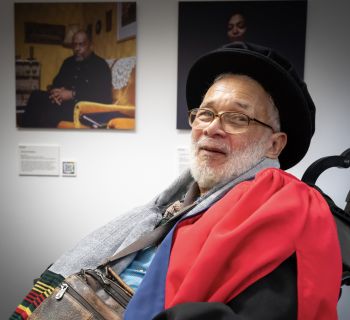
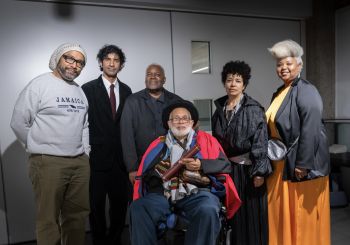
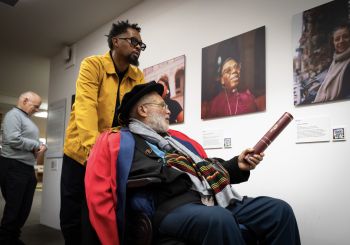
This autumn, the University of Sussex formally recognised that legacy. At the Black at Sussex Conference on Tuesday 27 October 2026, Charlie was conferred Honorary Doctor of the University: a moment of celebration for him, for the people in his photographs, and for everyone who gathered on campus to share in it.
Who is Charlie Phillips?
Born in Kingston, Jamaica, in 1944, Charlie spent his early childhood with his grandparents in rural St Mary before travelling to London aged eleven to join his parents in Notting Hill. The neighbourhood was home to a growing Caribbean community, living in tough conditions and facing real hostility.
His path into photography began almost by chance. An African-American serviceman left a camera with Charlie's father and never came back for it. Teaching himself from a book and learning through trial and error, the teenage Charlie began photographing the people and streets around him, developing his prints in the family bathroom late at night after his parents had gone to bed. At first, he imagined taking the pictures home to Jamaica to show his grandmother what his new life looked like.
Those pictures became something far bigger: an intimate, irreplaceable record of Notting Hill in the 1960s and beyond, from house parties, pubs and music clubs to the early days of Notting Hill Carnival. His 1967 portrait Notting Hill Couple is now held in the Tate collection.
Recognition did not come quickly. For years Charlie struggled to get his work published, and he supported himself as a waiter, a restaurateur and a merchant seaman. It was not until 1991, with the book Notting Hill in the Sixties and an accompanying exhibition at the Tabernacle, that wider audiences began to discover his work.
One of his most powerful bodies of work, How Great Thou Art, documents five decades of African-Caribbean funeral traditions in London: a tender record of how a community honours its loved ones. His photographs have since been shown at Tate Britain, the Museum of London and the National Portrait Gallery, and have appeared in publications including Life, Harper's Bazaar, Stern and Vogue. The historian Simon Schama has described him as "one of Britain's great photo-portraitists".
In 2022 Charlie was appointed OBE for services to photography and the arts, and since 2017 his life's work has been preserved through the Charlie Phillips Heritage Archive, supported by the National Lottery Heritage Fund.
A long connection with Sussex
Charlie's relationship with the University goes back several years. In 2020, working with fellow photographer Eddie Otchere, he photographed Black alumni of the University of Sussex for Black at Sussex, including academic Paul Gilroy, theatre director Lynette Linton and journalist Clive Myrie. Those portraits have been exhibited on campus, in the Library, putting the achievements of Sussex's Black alumni on the walls of the University for students, staff and visitors to see.
It is a fitting thread: the photographer who spent a lifetime making sure Black Britons were seen has helped Sussex see and celebrate its own community too.
The University's decision
The University's Honorary Degrees Committee recognises people who have achieved excellence in public, cultural and academic life. In awarding Charlie an Honorary Doctor of the University, Sussex has acknowledged not only his artistry but the historical importance of his work: a body of photography now regarded as a foundational part of Britain's cultural history.
Conferred at the Black at Sussex Conference
The honour was first announced in January 2026. Rather than an ordinary graduation ceremony, the conferment took place during the first ever Black at Sussex Conference, two days of Black experiences, knowledge, creativity and dialogue held on the University's Falmer campus.
Pro-Vice-Chancellor (Culture, Equality and Inclusion) Professor David Ruebain presented the award during a small intimate private ceremony.
For Black at Sussex, holding the conferment as part of the conference carried real meaning. It placed the recognition of a pioneering Black artist at the heart of a gathering created to celebrate Black achievement at Sussex and beyond, and it becomes part of the legacy the programme hopes to leave for future students.
Charlie received a standing ovation from over 80 students, staff and guests when entering the conference.
Charlie's response
Accepting the honour, Charlie was visibly moved.
For someone who has spoken openly about being overlooked for much of his career, being recognised in this way carries special weight. Earlier this year he reflected that, for a long time, people either didn't believe he had taken his own photographs or simply weren't interested. To be honoured by a university, surrounded by a community that knows exactly what his work means, marks how far that recognition has come.
A video interview with Charlie will be shared in a few weeks' time.
A lasting legacy
Charlie Phillips's photographs remind us that ordinary moments, such as a couple on a street corner, a dance in a crowded club or a family saying goodbye, are history too. In honouring him, the University of Sussex celebrates a life spent ensuring those moments, and the people in them, would not be forgotten.
Congratulations, Dr Charlie Phillips OBE.
Find out more about Charlie's work at the Charlie Phillips Heritage Archive: charliephillipsarchive.com