
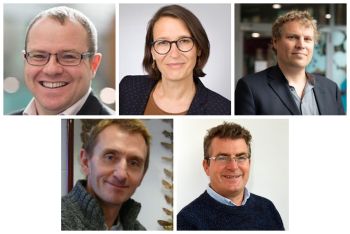
Clockwise: Professor Sovacool; Professor Rogge; Professor Creutzig; Professor Goulson; Professor Scoones
This year’s Clarivate Highly Cited Researchers list was published on 18 November, with four University of Sussex academics named in the list, and one from the Institute of Development Studies.
Clarivate is a global information-services company operating across research discovery, intellectual property, and life sciences. It publishes an annual list of top global scientists and social scientists recognised for exceptional research influence.
Selection draws on the Web of Science Core Collection to identify those with a global influence in their fields. Each researcher selected has authored multiple Highly Cited Papers which rank in the top 1% by citations for their fields and publication year in the Web of Science over the past 11 years.
The Sussex researchers named in the 2026 list are:
- Professor Benjamin Sovacool (University of Sussex Business School)
- Professor Felix Creutzig (University of Sussex Business School)
- Visiting Professor Karoline S. Rogge
- Professor Dave Goulson (School of Life Sciences; Faculty of Science, Engineering and Medicine)
- Professor Ian Scoones (Institute of Development Studies)
Professor Maria Fasli, Pro-Vice-Chancellor (Research & Innovation), said: “The Clarivate Highly Cited Researchers list is one of the most significant measures of academic impact, so it’s a real pleasure to see Sussex researchers and our partners recognised among the world’s most influential this year.
“Our strategy, Sussex 2035: Creating Progressive Futures - flourishing, sustainability and progress for the whole world, commits us to producing outstanding research and building partnerships that advance global knowledge equity. Having highly cited researchers on our faculty shows that Sussex is leading the way in innovative disciplinary research. I am delighted for everyone in our community who was named this year.”
Benjamin Sovacool, Professor of Energy Policy at the University’s Science Policy Research Unit (SPRU), said: “It’s amazing to be placed on this list again, sort of like the Michelin Star for academics. It wouldn’t have been possible without the deeply important mentors I had to help me on my academic journey, along with outstanding leadership at SPRU and the Business School, along with support from the Peter Bennett Foundation. I am grateful, truly, to you all.”
Felix Creutzig, Professor of Innovation and Policy Acceleration and Bennett Institute Chair, said: “It is a great honour to be listed as highly cited researcher. I would like to use the opportunity to highlight that is also thanks to being part of a wonderful network of scientists, and in some cases, like in the case of geospatial AI, it is PhD students who drive the method innovation and the cool novel results."
Karoline Rogge, Visiting Professor in Sustainability Innovation and Policy at the University of Sussex Business School, said: “I’m delighted to be back on the Highly Cited Researchers list. This recognition reflects the inspiring collaborations with colleagues, doctoral researchers and project partners, supported by funders such as the European Research Council. I’m grateful to the wider academic community whose engagement with research on policy mixes and accelerating net-zero transitions has helped these ideas inform research and policy debates around the world.”
Dave Goulson, Professor of Biology, and long-time list member, said: “I’m honoured to feature in this list for the tenth year running. As always, the credit really belongs with the long line of superb PhD students and postdocs who did all the hard work.”
Ian Scoones, Professorial Fellow at the Institute of Development Studies, located on the University of Sussex campus, said: “Sustained research requires long term collaborations, and in my case they are mostly in Africa. This recognition is once again shared with many other co-authors and colleagues in Zimbabwe, Kenya and beyond. And generous funding from the European Research Council over many years has made it all possible.”